Specifications, certifications and market rules apply to the exact model and destination. This guide supports commercial planning; importers should verify current legal obligations and model-specific evidence before sale.
Smart Home & IoT: reading the international market before asking for price
The commercial opportunity in smart home & iot comes from matching a clear buyer problem with a reliable product, not from collecting the largest possible catalogue. Shrih Trading Co. – Shrih Electronics develops manufacturing, sourcing, import and export programmes around connected-home devices where hardware, radio performance, cloud service, mobile application and data stewardship form one commercial product. The practical starting point is a country, a sales channel, a target customer and a realistic landed-cost position. Those four facts influence product grade, feature depth, packaging, documentation, minimum order quantity and the type of after-sales arrangement that will be credible in the destination.
International demand spans the UAE and wider GCC, Saudi Arabia, the United States, the United Kingdom, Germany and the European Union, Nigeria and West Africa, South Africa, Australia and New Zealand, Singapore, Southeast Asia. Yet the same item should not automatically be offered in identical form everywhere. Mains voltage, plug, radio use, language, climate, retail display, warranty practice and product-safety responsibilities vary. A distributor seeking dependable mid-market turnover may need fewer functions and more consistent stock; an online brand may need distinctive design, strong unboxing and content assets; a project buyer may value stable specifications, batch labelling and documentation above decorative packaging.
Prospective buyers include home-automation distributors, security installers, electrical wholesalers, property developers, telecom bundles, online smart-home brands, hospitality procurement teams. Shrih Electronics uses Standard, Premium and Industrial descriptors as commercial planning bands rather than universal technical certificates. The final quotation must define the model, bill of materials, test scope, pack and market documents. This prevents a buyer from comparing two prices that appear similar while representing different cells, chipsets, housings, accessories or quality controls.
Consider a practical range-planning scenario. A home-automation distributors serving the UAE and wider GCC could lead with Wi-Fi smart plugs, use outdoor security cameras as a complementary line and select a retail security carton after checking shelf, courier and freight constraints. The quotation should separate product cost, branding, pack, testing and logistics so the buyer can see which changes affect margin. The approved file should name the exact model, specification, included accessories, artwork revision and inspection points. Particular attention should be paid to cloud-service dependency. Before launch, the importer should verify market obligations and ensure that online titles, images and claims describe the shipped unit. After the first shipment, returns, reviews, sell-through and support questions should guide the replenishment specification rather than assumptions.
When a buyer moves from sample interest to a purchase order, A security installers serving Nigeria and West Africa could lead with Wi-Fi smart plugs, use outdoor security cameras as a complementary line and select a QR onboarding card after checking shelf, courier and freight constraints. The quotation should separate product cost, branding, pack, testing and logistics so the buyer can see which changes affect margin. The approved file should name the exact model, specification, included accessories, artwork revision and inspection points. Particular attention should be paid to poor firmware maintenance. Before launch, the importer should verify market obligations and ensure that online titles, images and claims describe the shipped unit. After the first shipment, returns, reviews, sell-through and support questions should guide the replenishment specification rather than assumptions.
- Confirm destination and importer
- Define target customer and channel
- State annual and opening quantities
- Set acceptable feature and cost range
- Identify mandatory documents before sampling
Smart Home & IoT: a complete product and category map for B2B range planning
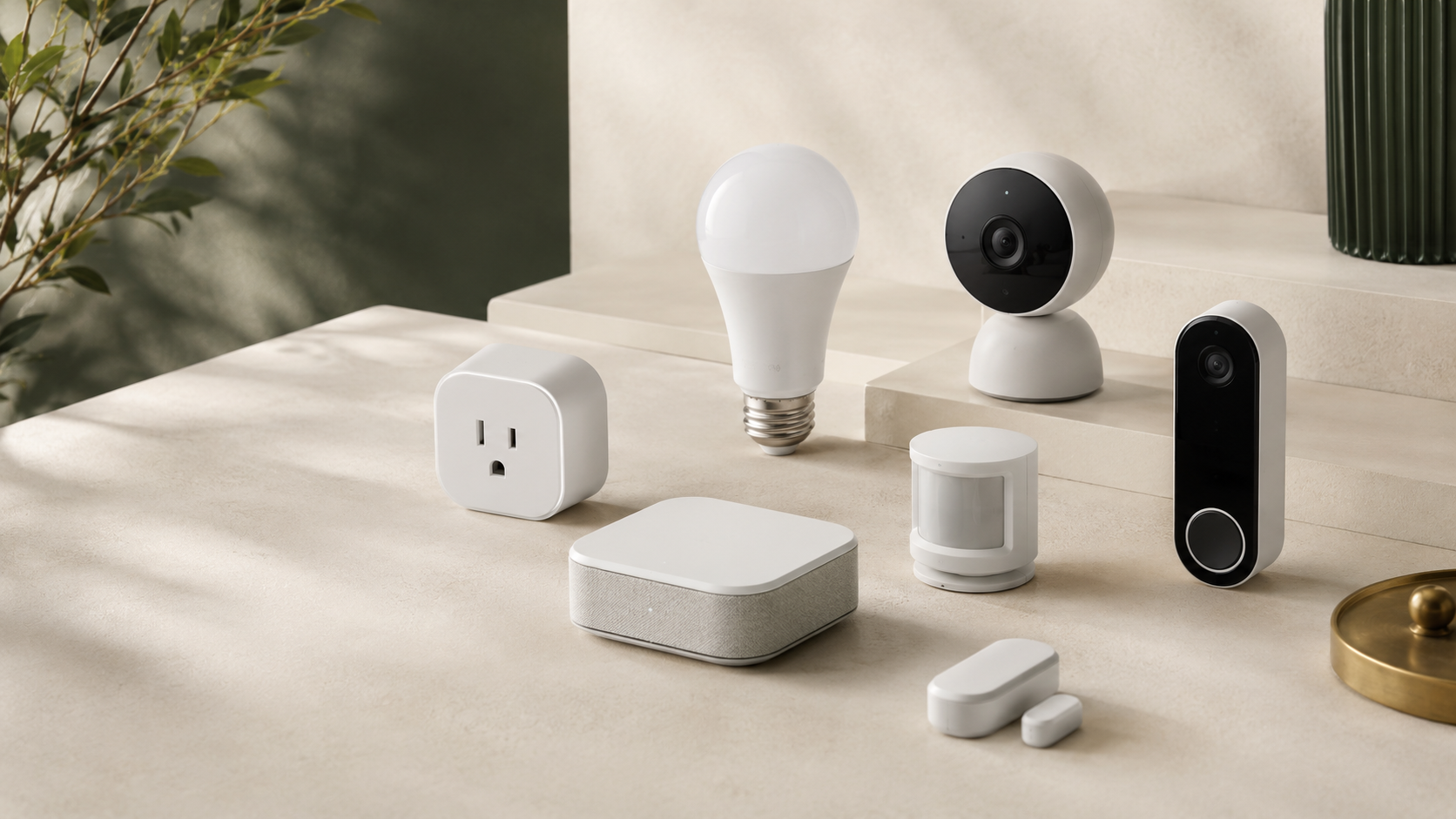
The working product map for this guide includes Wi-Fi smart plugs, smart power strips, smart bulbs, smart switches, indoor cameras, outdoor security cameras, video doorbells, baby monitors, motion sensors, door and window sensors, temperature sensors, smart hubs, IR blasters, smart locks, siren alarms. These names are useful for catalogue planning, distributor search, marketplace taxonomy and RFQ writing. The list is intentionally broad because buyers often create better programmes by combining a high-visibility hero product with repeat-purchase accessories and a practical entry-price option.
A range should be organised by use case and customer rather than by factory catalogue order. Group products into daily essentials, travel, work, fitness, home, beauty, entertainment, gifting or professional deployment where relevant. Then separate price and performance bands. This structure makes assortment gaps visible and reduces duplication between products that look different in photographs but solve the same task.
For image search, Pinterest and visual merchandising, each approved SKU should have a consistent image set: front three-quarter view, side or port detail, scale view, package view, accessory layout and one accurate use-context image. File names, captions and alternative text should use the exact generic product name, key feature and model code. Visual assets must match the shipped version; a photo of an earlier housing or connector creates returns and weakens trust.
A second commercial lens is useful. A security installers serving Saudi Arabia could lead with smart power strips, use video doorbells as a complementary line and select a project bulk pack after checking shelf, courier and freight constraints. The quotation should separate product cost, branding, pack, testing and logistics so the buyer can see which changes affect margin. The approved file should name the exact model, specification, included accessories, artwork revision and inspection points. Particular attention should be paid to weak privacy disclosures. Before launch, the importer should verify market obligations and ensure that online titles, images and claims describe the shipped unit. After the first shipment, returns, reviews, sell-through and support questions should guide the replenishment specification rather than assumptions.
Smart Home & IoT: alternative trade names that importers and buyers actually use
Popular alternative trade names include connected-home devices, home automation products, IoT accessories, Wi-Fi appliances, smart security devices, app-controlled gadgets, home sensors. These phrases should appear naturally in product copy when they are accurate, because buyers search differently across regions and channels. A procurement officer may use a formal category, a wholesaler may use a short trade term and a consumer marketplace may favour a familiar retail phrase. Synonyms improve discovery only when the underlying product remains unambiguous.
Every title should still lead with the most exact product identity. Trade names must not blur an important distinction such as wired versus wireless, battery versus mains power, cosmetic versus medical intended use, indoor versus outdoor use, or compatible versus formally certified. A keyword can attract a visit, but the specification and images must let the buyer determine exactly what is being offered.
Shrih Electronics recommends a controlled naming sheet for each programme. It records the approved generic name, buyer-facing name, customs description, carton description, model code and marketplace title. That sheet supports consistent invoices, packing lists, artwork, online listings and quality reports while allowing market-specific SEO phrases in descriptive text.
For procurement teams building a repeat programme, A electrical wholesalers serving the United States could lead with smart bulbs, use baby monitors as a complementary line and select a installer-labelled kit after checking shelf, courier and freight constraints. The quotation should separate product cost, branding, pack, testing and logistics so the buyer can see which changes affect margin. The approved file should name the exact model, specification, included accessories, artwork revision and inspection points. Particular attention should be paid to unsupported radio frequencies. Before launch, the importer should verify market obligations and ensure that online titles, images and claims describe the shipped unit. After the first shipment, returns, reviews, sell-through and support questions should guide the replenishment specification rather than assumptions.
- connected-home devices
- home automation products
- IoT accessories
- Wi-Fi appliances
- smart security devices
- app-controlled gadgets
- home sensors
Smart Home & IoT: turning a product idea into a quotation-ready specification
A useful RFQ describes the required outcome and the measurable attributes. For this category, buyers should consider Wi-Fi band, Bluetooth or Zigbee support, app and cloud platform, camera resolution, night vision, local storage, privacy controls, power input, relay rating, sensor range, operating temperature. Add expected quantity, destination, delivery window, target channel, preferred pack, warranty expectation and any approved benchmark sample. If a value is flexible, give a range and explain the priority behind it.
Specifications must describe the complete saleable unit. The main device alone is not enough: cable, adapter, charging case, attachments, manuals, inserts, protective films, retail labels and software access can change cost and acceptance. State which elements are included, optional or supplied by the buyer. Where technical equivalents are permitted, define the performance boundary and approval process before production.
The commercial schedule should reference a dated specification or signed sample. Product pages and catalogues can summarise benefits, but the purchase order should link to controlled technical information. This matters for repeat orders, because component availability can change. Any proposed substitution must be documented, evaluated and approved rather than silently introduced.
When a buyer moves from sample interest to a purchase order, A property developers serving the United Kingdom could lead with smart switches, use motion sensors as a complementary line and select a QR onboarding card after checking shelf, courier and freight constraints. The quotation should separate product cost, branding, pack, testing and logistics so the buyer can see which changes affect margin. The approved file should name the exact model, specification, included accessories, artwork revision and inspection points. Particular attention should be paid to poor firmware maintenance. Before launch, the importer should verify market obligations and ensure that online titles, images and claims describe the shipped unit. After the first shipment, returns, reviews, sell-through and support questions should guide the replenishment specification rather than assumptions.
- Wi-Fi band
- Bluetooth or Zigbee support
- app and cloud platform
- camera resolution
- night vision
- local storage
- privacy controls
- power input
- relay rating
- sensor range
- operating temperature
Smart Home & IoT: defining Standard, Premium, Industrial programmes without vague claims
Standard grade should mean a commercially dependable configuration for price-aware retail, not an excuse for undefined components. Premium grade may add stronger materials, better display or acoustic elements, higher power, refined controls, upgraded packaging or longer support. Industrial grade should be used only when the construction, operating environment, duty cycle, test plan and documentation genuinely support that description.
A buyer can compare grades through a feature matrix that shows the exact model, core component, rated performance, housing, finish, accessory set, quality checks, pack and warranty route. Avoid adjectives such as best, military, professional, medical, clinical or waterproof unless they have a defined, supportable meaning. Measurable differences produce better purchasing decisions and safer marketing.
For a first shipment, it is often better to select one dependable core model plus one premium variant than to launch many shallow variations. Concentrated quantity improves branding efficiency, spare planning, inspection and content creation. The assortment can expand after sales data identifies the features, colours and price points that genuinely move in the destination market.
Consider a practical range-planning scenario. A telecom bundles serving Germany and the European Union could lead with indoor cameras, use door and window sensors as a complementary line and select a OEM box after checking shelf, courier and freight constraints. The quotation should separate product cost, branding, pack, testing and logistics so the buyer can see which changes affect margin. The approved file should name the exact model, specification, included accessories, artwork revision and inspection points. Particular attention should be paid to insecure default settings. Before launch, the importer should verify market obligations and ensure that online titles, images and claims describe the shipped unit. After the first shipment, returns, reviews, sell-through and support questions should guide the replenishment specification rather than assumptions.
Smart Home & IoT: matching products to distributors, retail, e-commerce and projects
Channel fit changes the product brief. A distributor needs margin structure, repeat availability and cartons that survive multiple handling points. A modern retail chain needs shelf dimensions, barcode discipline, clear claims and predictable replenishment. An e-commerce seller needs protective mail-order packaging, accurate media and a return-resistant user experience. A project buyer may require asset labels, batch records, simplified packing and scheduled site deliveries.
The same housing can sometimes support different channel packs, but model identity and compliance records must remain controlled. If accessories, firmware, power adapters or marketing claims change, the variant may need separate review. Buyers should therefore decide which changes are cosmetic and which create a technically different saleable product.
Shrih Electronics can coordinate wholesale, OEM, white-label and project supply after commercial confirmation. The buyer remains responsible for the legal placement of goods in its market and should involve its importer, compliance adviser and insurer early. Clear role allocation prevents late disputes about labels, authorised representatives, recycling obligations, registrations and customer support.
A second commercial lens is useful. A online smart-home brands serving Nigeria and West Africa could lead with outdoor security cameras, use temperature sensors as a complementary line and select a multilingual manual set after checking shelf, courier and freight constraints. The quotation should separate product cost, branding, pack, testing and logistics so the buyer can see which changes affect margin. The approved file should name the exact model, specification, included accessories, artwork revision and inspection points. Particular attention should be paid to ratings unsuitable for local mains supply. Before launch, the importer should verify market obligations and ensure that online titles, images and claims describe the shipped unit. After the first shipment, returns, reviews, sell-through and support questions should guide the replenishment specification rather than assumptions.
Smart Home & IoT: power, batteries, charging and real-world performance
Power specifications require precise language. Battery capacity in milliamp-hours does not by itself state usable runtime or delivered energy. Voltage, watt-hours, conversion losses, operating mode, display brightness, wireless activity, volume, motor load or lighting level all affect experience. Published runtime should identify test conditions, and buyers should verify representative production samples rather than rely only on a catalogue headline.
Charging information should state port, input profile, compatible protocol, included cable and whether an adapter is supplied. USB Type-C describes a connector, not automatically high data speed or USB Power Delivery. Likewise, fast-charge, magnetic and wireless claims need the supported protocol and maximum rated output. Safety functions and thermal behaviour should be examined under expected use.
For battery-powered goods, the file set may include cell information, safety reports, UN 38.3 test summary, watt-hour value, packaging instructions and transport declarations depending on shipment mode and configuration. Airlines, forwarders and authorities can impose current requirements. Shipment planning should begin before the final carton is locked, especially for power banks and loose batteries that are treated differently from batteries contained in equipment.
For procurement teams building a repeat programme, A hospitality procurement teams serving South Africa could lead with video doorbells, use smart hubs as a complementary line and select a retail security carton after checking shelf, courier and freight constraints. The quotation should separate product cost, branding, pack, testing and logistics so the buyer can see which changes affect margin. The approved file should name the exact model, specification, included accessories, artwork revision and inspection points. Particular attention should be paid to cloud-service dependency. Before launch, the importer should verify market obligations and ensure that online titles, images and claims describe the shipped unit. After the first shipment, returns, reviews, sell-through and support questions should guide the replenishment specification rather than assumptions.
Smart Home & IoT: wireless protocols, companion apps and interoperability
Connected products combine hardware with a radio stack, firmware, application and sometimes a cloud service. The RFQ should identify Bluetooth, Wi-Fi, Zigbee or other protocols, supported bands, required profiles, operating-system compatibility, onboarding steps, update mechanism and offline behaviour. A feature shown in a sample is not commercially dependable unless the associated service and licences remain available.
Bluetooth branding and logos have qualification requirements. A supplier's module qualification does not automatically settle every obligation for the final buyer-branded product. Similar care applies to Qi, USB and other technology marks: use certification language and logos only when the final product has the appropriate completed process and verifiable identity. Compatibility wording must not impersonate certification.
Apps introduce privacy, security and lifecycle questions. Buyers should ask who controls the developer account, where data is processed, how permissions are explained, how accounts are deleted, whether firmware is signed and how long updates are planned. A low-cost device can create a high-cost brand problem if its app disappears or requests excessive access.
When a buyer moves from sample interest to a purchase order, A home-automation distributors serving Australia and New Zealand could lead with baby monitors, use IR blasters as a complementary line and select a project bulk pack after checking shelf, courier and freight constraints. The quotation should separate product cost, branding, pack, testing and logistics so the buyer can see which changes affect margin. The approved file should name the exact model, specification, included accessories, artwork revision and inspection points. Particular attention should be paid to weak privacy disclosures. Before launch, the importer should verify market obligations and ensure that online titles, images and claims describe the shipped unit. After the first shipment, returns, reviews, sell-through and support questions should guide the replenishment specification rather than assumptions.
Smart Home & IoT: materials, finish, ergonomics and durability at sample stage
The approved sample should be reviewed as an object, not only as a function list. Examine housing resin or metal, surface texture, colour consistency, seams, edges, buttons, hinges, connectors, cable strain relief, screen fit, feet, straps and skin-contact surfaces where relevant. Small physical details strongly influence perceived quality and return rates.
Materials should be linked to intended use. Heat, UV, sweat, cosmetics, outdoor exposure, flexing, repeated plugging, drops and cleaning can expose weaknesses that are invisible in a new sample. The buyer and factory should agree practical tests based on product risk rather than copying a generic checklist. Test severity and pass criteria must be recorded.
Colour and finish require references. Digital renders are not sufficient for production approval; use colour codes, texture references and signed physical samples where appearance matters. Packaging inserts must not rub or mark the product during transport. Protective films should be removable without residue, and retail surfaces should arrive clean enough for immediate sale.
Consider a practical range-planning scenario. A security installers serving Singapore could lead with motion sensors, use smart locks as a complementary line and select a installer-labelled kit after checking shelf, courier and freight constraints. The quotation should separate product cost, branding, pack, testing and logistics so the buyer can see which changes affect margin. The approved file should name the exact model, specification, included accessories, artwork revision and inspection points. Particular attention should be paid to unsupported radio frequencies. Before launch, the importer should verify market obligations and ensure that online titles, images and claims describe the shipped unit. After the first shipment, returns, reviews, sell-through and support questions should guide the replenishment specification rather than assumptions.
Smart Home & IoT: eco, retail-ready and OEM packaging that protects the sale
Available packaging directions include retail security carton, project bulk pack, installer-labelled kit, QR onboarding card, OEM box, multilingual manual set. Selection should reflect channel, product fragility, theft risk, display method, sustainability policy, unboxing objective and freight efficiency. Eco-friendly does not mean under-protected; right-sized paper structures, moulded pulp and reduced plastic should still survive the defined distribution route.
OEM packaging typically coordinates product name, model, feature claims, barcode, serial or batch data, importer information, regulatory marks, warnings, contents, voltage, disposal symbols, country of origin and language. Each statement should be checked against the final device and destination rules. Artwork approval is a technical gate, not only a graphic-design step.
Master cartons need unit count, gross and net weight, dimensions, handling marks and shipping identity. Buyers should request a packing specification and representative packed sample. For e-commerce, the retail carton may need an outer mailer or stronger internal support. For gift programmes, the presentation box must hold every component securely and remain practical to pack at scale.
A second commercial lens is useful. A electrical wholesalers serving Southeast Asia could lead with door and window sensors, use siren alarms as a complementary line and select a QR onboarding card after checking shelf, courier and freight constraints. The quotation should separate product cost, branding, pack, testing and logistics so the buyer can see which changes affect margin. The approved file should name the exact model, specification, included accessories, artwork revision and inspection points. Particular attention should be paid to poor firmware maintenance. Before launch, the importer should verify market obligations and ensure that online titles, images and claims describe the shipped unit. After the first shipment, returns, reviews, sell-through and support questions should guide the replenishment specification rather than assumptions.
- retail security carton
- project bulk pack
- installer-labelled kit
- QR onboarding card
- OEM box
- multilingual manual set
Smart Home & IoT: quality assurance from golden sample to final random inspection
A suitable quality path can include onboarding and reset test, Wi-Fi reconnection, notification-latency check, camera image review, relay load verification, sensor trigger sampling, firmware-update test, account deletion flow review, accessory completeness. The exact plan should be proportionate to product risk, order value and destination. Critical safety and identity checks should be distinguished from major functional issues and minor cosmetic defects. Sampling levels, inspection conditions and decision authority should be agreed before the goods are complete.
The golden sample defines the accepted model, finish, accessory set, firmware and package. Inspection documents should carry model and batch identity so reports cannot be confused with another item. Where performance claims matter, identify the instrument, method and tolerance. Photos are useful evidence but do not replace numerical results for capacity, power, temperature, output or dimensions.
Corrective action should address cause, containment and prevention. Reworking a visible defect without understanding its source can allow the same issue into the next lot. Keep a retain sample and final approved artwork with the order file. For repeat manufacturing, review any component, firmware, tooling, label or factory change before production.
For procurement teams building a repeat programme, A property developers serving the UAE and wider GCC could lead with temperature sensors, use Wi-Fi smart plugs as a complementary line and select a OEM box after checking shelf, courier and freight constraints. The quotation should separate product cost, branding, pack, testing and logistics so the buyer can see which changes affect margin. The approved file should name the exact model, specification, included accessories, artwork revision and inspection points. Particular attention should be paid to insecure default settings. Before launch, the importer should verify market obligations and ensure that online titles, images and claims describe the shipped unit. After the first shipment, returns, reviews, sell-through and support questions should guide the replenishment specification rather than assumptions.
- onboarding and reset test
- Wi-Fi reconnection
- notification-latency check
- camera image review
- relay load verification
- sensor trigger sampling
- firmware-update test
- account deletion flow review
- accessory completeness
Smart Home & IoT: CE, RoHS, FCC, BIS and technology certification explained responsibly
Certification must be model-specific and market-specific. Relevant frameworks or programmes may include radio and EMC assessment, CE or FCC route for relevant models, RoHS, Bluetooth or other alliance qualification where claimed, electrical safety, cybersecurity and privacy obligations, destination radio type approval. CE is not a universal quality certificate; it applies where EU harmonisation legislation requires it and follows the appropriate conformity process. RoHS addresses restricted substances in electrical and electronic equipment. FCC requirements depend on radio-frequency characteristics and the US authorisation route. BIS applies compulsorily to notified categories in India and should be checked against the current official list.
A report for a similar-looking product, battery, radio module or earlier model is not automatically evidence for the final shipment. Buyers should request the declaration, report, certificate, registration, ID or listing that is appropriate, confirm model names and technical scope, and have the responsible market party verify applicability. Logos must not be printed simply because they are familiar to consumers.
Other destinations can require local responsible suppliers, registrations, radio approvals, electrical safety, energy labels, recycling duties or marks such as Australia's RCM. Great Britain currently provides routes involving CE or UKCA for relevant product areas, but the exact rules and product legislation must be checked. Compliance planning is therefore a pre-order workstream, not a document request made when cartons are ready.
When a buyer moves from sample interest to a purchase order, A telecom bundles serving Saudi Arabia could lead with smart hubs, use smart power strips as a complementary line and select a multilingual manual set after checking shelf, courier and freight constraints. The quotation should separate product cost, branding, pack, testing and logistics so the buyer can see which changes affect margin. The approved file should name the exact model, specification, included accessories, artwork revision and inspection points. Particular attention should be paid to ratings unsuitable for local mains supply. Before launch, the importer should verify market obligations and ensure that online titles, images and claims describe the shipped unit. After the first shipment, returns, reviews, sell-through and support questions should guide the replenishment specification rather than assumptions.
- radio and EMC assessment
- CE or FCC route for relevant models
- RoHS
- Bluetooth or other alliance qualification where claimed
- electrical safety
- cybersecurity and privacy obligations
- destination radio type approval
Smart Home & IoT: export packing, lithium batteries, documentation and landed delivery
The logistics file should describe product, quantity, harmonised-system classification for adviser review, unit and carton weights, dimensions, battery configuration, country of origin and Incoterm. Typical commercial documents can include quotation or proforma invoice, purchase order, commercial invoice, packing list, transport document, certificate of origin where requested and product-specific records. Requirements vary by shipment and destination.
Lithium-powered devices need early freight coordination. IATA and carrier rules distinguish batteries shipped alone, packed with equipment and contained in equipment; power banks are treated as batteries for transport purposes. The manufacturer or shipper should provide accurate watt-hour and test information, while the forwarder confirms current acceptance, labels, state-of-charge or packing conditions and routing.
Landed-cost comparison must include product, pack, inland movement, export handling, freight, insurance, duty, taxes, compliance work, marketplace fees, warranty reserve and local distribution. The lowest FOB unit price may produce a higher landed cost if cartons waste volume, failures create returns or the model cannot be lawfully placed on the market.
Consider a practical range-planning scenario. A online smart-home brands serving the United States could lead with IR blasters, use smart bulbs as a complementary line and select a retail security carton after checking shelf, courier and freight constraints. The quotation should separate product cost, branding, pack, testing and logistics so the buyer can see which changes affect margin. The approved file should name the exact model, specification, included accessories, artwork revision and inspection points. Particular attention should be paid to cloud-service dependency. Before launch, the importer should verify market obligations and ensure that online titles, images and claims describe the shipped unit. After the first shipment, returns, reviews, sell-through and support questions should guide the replenishment specification rather than assumptions.
Smart Home & IoT: adapting the same product family for ten priority export regions
Shrih Electronics supports enquiries for the UAE and wider GCC, Saudi Arabia, the United States, the United Kingdom, Germany and the European Union, Nigeria and West Africa, South Africa, Australia and New Zealand, Singapore, Southeast Asia. The product platform may remain similar, but the shipment can require different plug, language, importer information, market documentation, radio configuration, retail price architecture and warranty communication. A separate market-variant code reduces mistakes.
GCC buyers may prioritise heat-aware construction, bilingual content and local type approval where applicable. EU and UK buyers commonly examine product safety, EMC, radio, substances, labelling, responsible economic operators and recycling duties. US buyers focus on applicable FCC pathways, consumer claims and channel requirements. Australia uses responsible-supplier and RCM processes for regulated products. African and Southeast Asian markets are diverse and require country-level review rather than regional assumptions.
A buyer should nominate the legal importer or responsible market party and confirm obligations with competent advisers. Shrih can coordinate product and factory evidence, but no exporter should promise that one certificate makes an item legal everywhere. A market-access matrix should be signed off before mass artwork and production.
A second commercial lens is useful. A hospitality procurement teams serving the United Kingdom could lead with smart locks, use smart switches as a complementary line and select a project bulk pack after checking shelf, courier and freight constraints. The quotation should separate product cost, branding, pack, testing and logistics so the buyer can see which changes affect margin. The approved file should name the exact model, specification, included accessories, artwork revision and inspection points. Particular attention should be paid to weak privacy disclosures. Before launch, the importer should verify market obligations and ensure that online titles, images and claims describe the shipped unit. After the first shipment, returns, reviews, sell-through and support questions should guide the replenishment specification rather than assumptions.
Smart Home & IoT: the final RFQ, sample, MOQ, pricing and partnership checklist
A complete enquiry states company, country, channel, selected products, model or benchmark, required specifications, opening quantity, forecast, target date, pack, branding, documents, Incoterm and destination. It should distinguish mandatory requirements from preferences. Shrih Trading Co. – Shrih Electronics can then evaluate manufacturing in India and sourcing through qualified partners in China and Taiwan according to the programme.
MOQ depends on product, component, colour, logo method, printed packaging and test scope. Standard inventory may support a smaller commercial start; full OEM development requires quantities that justify setup, artwork, materials and quality control. Sample, pilot and bulk timelines should be stated separately. Price validity must reflect component and freight conditions.
Send the brief to info@shrihtrading.com or WhatsApp +91 8169390366. Include destination, estimated quantity and required delivery month in the first message. A strong long-term partnership uses clear approvals, prompt change control, realistic forecasts, model-specific documentation, inspection evidence and honest product marketing. Those disciplines matter more than a catalogue with thousands of unexplained SKUs.
For procurement teams building a repeat programme, A home-automation distributors serving Germany and the European Union could lead with siren alarms, use indoor cameras as a complementary line and select a installer-labelled kit after checking shelf, courier and freight constraints. The quotation should separate product cost, branding, pack, testing and logistics so the buyer can see which changes affect margin. The approved file should name the exact model, specification, included accessories, artwork revision and inspection points. Particular attention should be paid to unsupported radio frequencies. Before launch, the importer should verify market obligations and ensure that online titles, images and claims describe the shipped unit. After the first shipment, returns, reviews, sell-through and support questions should guide the replenishment specification rather than assumptions.
- Company and destination
- Product and model
- Quantity and annual forecast
- Technical specification
- Branding and packaging
- Compliance documents
- Incoterm and delivery point
- Required timeline
PRACTICAL ANSWERS
Smart Home & IoT: frequently asked questions from B2B buyers
What information is required for a gadget quotation?
Share product names, specifications, quantity, destination, sales channel, target delivery, packaging, branding and required market documents. For smart home & iot, a benchmark link or sample is useful only when the buyer also states which features are essential.
Can Shrih Electronics supply OEM and private-label packaging?
Yes, subject to product, quantity and feasibility. Options may include retail security carton, project bulk pack, installer-labelled kit, QR onboarding card, OEM box, multilingual manual set. Final artwork, labels, claims and importer details require buyer approval before production.
Are all products CE, RoHS, FCC and BIS certified?
No responsible supplier should make that blanket statement. Applicability and evidence depend on the exact model, function and destination. Shrih coordinates available model-specific documentation, while the importer verifies the legal route for its market.
What is the normal minimum order quantity?
MOQ varies by model, colour, branding, printed pack, component commitment and testing. A stock configuration may start lower than a fully customised OEM programme. Send the expected opening order and annual forecast for a relevant answer.
Can buyers request Standard, Premium, Industrial quality?
These are planning bands and must be translated into measurable specifications. The quotation should define components, ratings, housing, accessories, inspection, pack and support rather than relying on the grade name alone.
How are lithium-battery products prepared for export?
The final device and shipping configuration determine the requirements. Battery identity, watt-hours, UN 38.3 evidence, packing and carrier acceptance should be coordinated with the factory and forwarder before booking.
Can Shrih source from India, China and Taiwan?
Shrih Electronics can evaluate Indian production and qualified sourcing partners in China and Taiwan according to product capability, quantity, component ecosystem, commercial fit and destination needs.
What should be approved before bulk production?
Approve the final model, Wi-Fi band, Bluetooth or Zigbee support, app and cloud platform, camera resolution, night vision, included accessories, golden sample, packaging artwork, quality plan, documents and delivery schedule. Any change after approval should be recorded.
Which markets does Shrih Electronics support?
Enquiries are welcomed for the UAE and wider GCC, Saudi Arabia, the United States, the United Kingdom, Germany and the European Union, Nigeria and West Africa, South Africa, Australia and New Zealand, Singapore, Southeast Asia, subject to commercial feasibility and destination requirements. The buyer should identify the importer and confirm local obligations.
How can a buyer start?
Email info@shrihtrading.com or WhatsApp +91 8169390366 with company name, country, product, quantity, specification, packaging and required delivery month. A complete brief receives a more accurate commercial response.
PRIMARY SOURCES
Smart Home & IoT: official standards and market-access reference desk
These official resources help buyers verify current requirements. They do not prove certification of a quoted product; request evidence linked to the exact final model.
- European Commission CE marking guidance ↗
- European Commission RoHS overview ↗
- Bureau of Indian Standards compulsory products ↗
- US FCC equipment authorisation ↗
- IATA lithium-battery resources ↗
- Bluetooth SIG qualification guidance ↗
- European Commission Radio Equipment Directive ↗
- US FDA general wellness device policy ↗
- US FDA smartwatch blood-glucose safety communication ↗
- USB-IF Power Delivery specifications ↗
- Wireless Power Consortium certified products ↗
- Australian RCM supplier guidance ↗
- UK product marking guidance ↗